
Banking & Finance
Ghaziabad CBI Court Sentences Man to Over 3 Years in ₹99 Lakh Loan Fraud Case

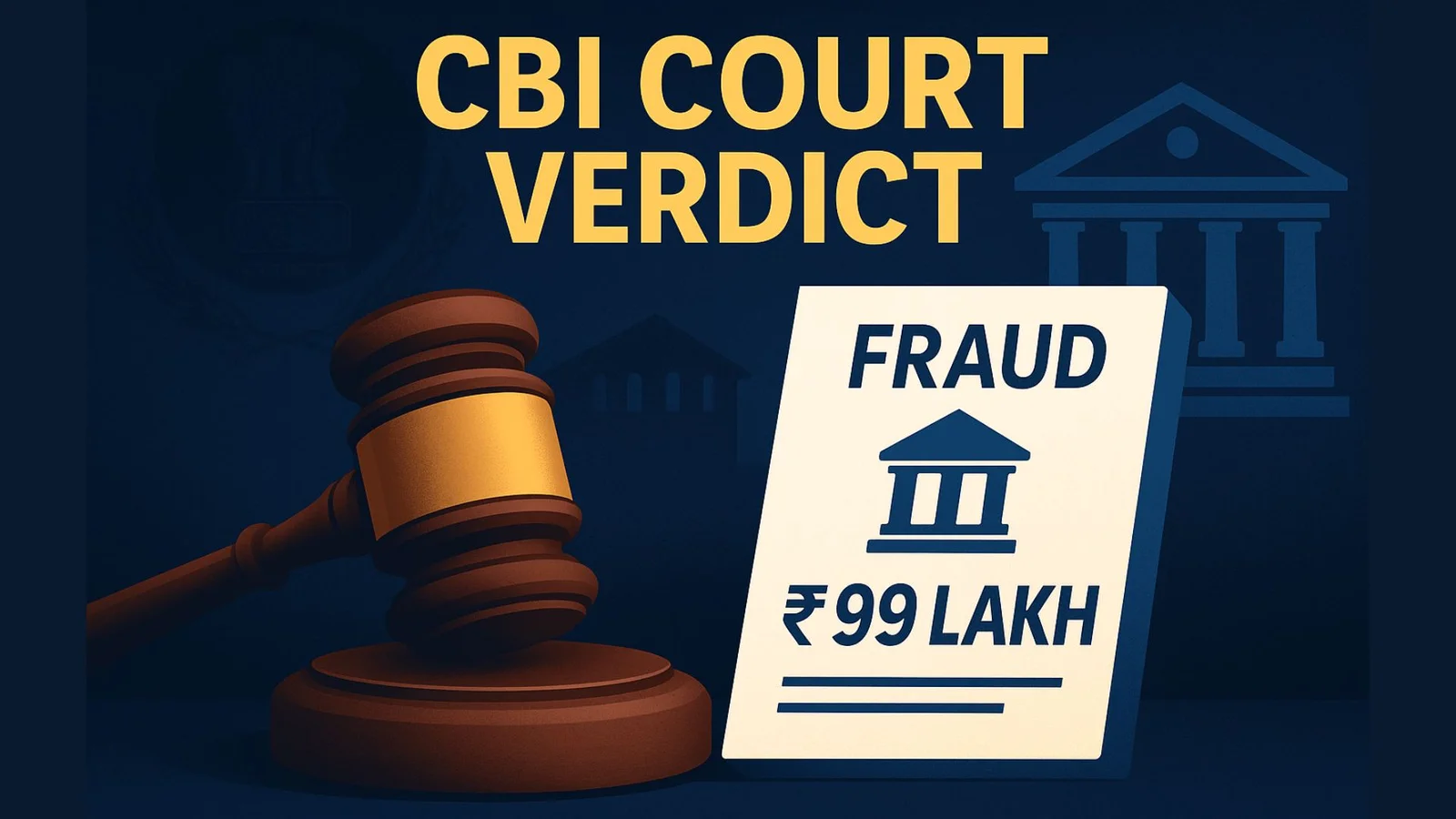
Ghaziabad | November 21, 2025 — A Special CBI Court in Ghaziabad has sentenced Kapil Kumar, a private individual, to three years, seven months, and ten days of simple imprisonment along with a ₹50,000 fine for orchestrating a large-scale bank loan fraud. The verdict, delivered on Friday, relates to a 2017 housing loan scam involving forged documents and misuse of sanctioned funds.
Loan Fraud Case Originated in 2017
The Central Bureau of Investigation (CBI) registered the case on 13 September 2017 after detecting irregularities in the approval of a ₹99 lakh housing loan. According to investigators, Kapil Kumar—acting in collusion with other private persons—submitted forged property papers, fake identification documents, manipulated income statements, and incomplete loan documents to secure the loan in his and his wife Manisha Devi’s name.
The fraudulent documentation was crafted to avoid mandatory verification and mislead bank officials during the loan approval process.
Misappropriation of ₹96 Lakh After Loan Sanction
Once the loan was sanctioned, Kumar allegedly withdrew around ₹96 lakh from the loan account. Instead of using the funds for purchasing or developing the proposed plot, he diverted the money for unauthorized purposes.
CBI officials confirmed that the fraudulent actions, involving both private and public individuals, caused a wrongful loss of ₹1,17,66,950 to Canara Bank’s Ghaziabad branch (formerly Syndicate Bank).
Charge Sheet Filed After Detailed Probe
Following years of investigation, the CBI filed its charge sheet on 23 December 2021, naming Kapil Kumar along with other accused individuals, including government officials.
The Special Court framed formal charges on 18 July 2025, after which the trial commenced. The prosecution submitted bank records, forensic reports confirming document forgery, and multiple witness testimonies to establish cheating, criminal conspiracy, and forgery under relevant laws.
Accused Pleads Guilty During Trial
In a major turning point, Kapil Kumar submitted a guilty plea application on 12 November 2025. After ensuring the plea was voluntary, the Special Judge of CBI Anti-Corruption Court No. 1 accepted the application and convicted the accused.
Court Stresses Need for Stronger Financial Safeguards
While announcing the sentence, the court underscored the critical impact of financial fraud on public institutions.
The judge remarked:
“Loan fraud and misuse of sanctioned funds compromise institutional integrity and demand strict punitive measures to deter future offenses.”
The court emphasized that stronger scrutiny, verification, and ethical compliance are essential to protect public financial systems.
CBI Welcomes Verdict as Boost to Financial Transparency
The CBI praised the judgment, noting that the sentencing reinforces ongoing efforts to curb financial crimes in banking institutions. Officials stated that the case underscores the consequences of manipulating public finance mechanisms and serves as a deterrent against similar fraudulent practices.
The ruling is viewed as an important step toward enhancing accountability, transparency, and trust in India’s lending ecosystem.


A retired government employee in Uttar Pradesh’s Etah district has alleged that ₹4.49 lakh was fraudulently withdrawn from his State Bank of India (SBI) savings account through multiple online transactions. The complainant has also claimed that his registered mobile number and nominee details were changed without his consent, raising concerns about possible procedural lapses or internal involvement.
Police have received a complaint, and the matter is expected to be investigated.
Fraud Discovered During Passbook Update
According to the complaint, Chaitanya Prakash Paliwal, a resident of Jaitra, maintains a pension account at the State Bank of India (SBI), Jaitra branch, where his monthly pension is deposited.
Paliwal stated that his account balance stood at approximately ₹12.73 lakh on June 5, 2024. However, when he visited the branch on July 3 to update his passbook, he discovered that ₹4,49,128 had allegedly been withdrawn through 95 online transactions that he claims he neither initiated nor authorized.
The complainant further alleged that the account nominee had been changed from his wife, Sarvesh Paliwal, to an individual identified as Mohammad Furkan, whom he says he does not know.
Customer Claims He Never Used Digital Payment Apps
Paliwal told authorities that he has never used digital payment platforms such as PhonePe or similar mobile payment applications.
He suspects that fraudsters first changed the mobile number registered with his bank account, enabling them to receive transaction alerts and one-time passwords (OTPs), thereby allowing unauthorized online transfers without his knowledge.
Following the discovery, the complainant submitted a written request to the bank seeking restoration of his original registered mobile number and nominee details. He also filed a complaint with the Jaitra Police Station requesting criminal action.
According to the complaint, such changes could not have occurred without serious procedural failures or possible internal collusion. These allegations have not been independently verified.
Investigation Likely to Examine Banking Records
At the time of reporting, no official statement had been issued by the SBI branch regarding the allegations.
If a formal criminal case is registered, investigators are expected to examine KYC records, account modification requests, internal banking logs, digital audit trails, IP addresses, and transaction histories to determine how the account details were allegedly altered and whether banking procedures were properly followed.
Experts Urge Customers to Monitor Account Details
Cybersecurity and banking experts advise customers to regularly verify their registered mobile number, email address, nominee information, and other KYC details to reduce the risk of account-related fraud.
They also recommend immediately reporting any suspicious banking activity to the bank, contacting the National Cyber Crime Helpline (1930), and filing a complaint through the National Cyber Crime Reporting Portal, as prompt reporting can improve the chances of freezing fraudulent transactions and recovering stolen funds.
The allegations remain under investigation, and no findings have yet established criminal liability. Any determination regarding responsibility will depend on the outcome of the police inquiry and any subsequent legal proceedings.
The Securities and Exchange Board of India (SEBI) has launched a new initiative to protect retail investors from the rising threat of fake trading platforms. The regulator now requires that only apps operated by SEBI-registered brokers can display a “Verified” label on the Google Play Store, helping users quickly identify genuine trading applications before downloading.
Surge in Fake Trading Apps
Over the past few years, cybercriminals have increasingly targeted retail investors using sophisticated fraudulent apps. These platforms often mimic legitimate trading apps, showing fabricated profits to build trust. Once users invest significant sums, the apps either block accounts or disappear, causing substantial financial losses. Experts note that organized networks use advanced social engineering tactics to manipulate victims.
Prof. Triveni Singh, cybercrime expert and former IPS officer, commented, “Fake digital platforms are a growing concern for investors. SEBI’s Verified label helps identify potential risks early, but ultimate security depends on user awareness and caution.”
SEBI’s “CVV” Formula for Safer Investing
SEBI has introduced a three-step verification model—CVV—to help investors safeguard their funds:
- Check – Verify bank account details using SEBI’s official tools.
- Validate – Confirm UPI IDs and payment channels are authentic.
- Verify – Ensure the trading app displays the Verified badge on Google Play.
This multi-layered approach empowers investors to detect red flags before committing money.
Public-Private Partnership with Google
The Verified label initiative has been implemented in collaboration with Google, reflecting a strong public-private partnership. The system allows Google Play to monitor, detect, and remove unauthorized or suspicious apps, adding a platform-level layer of security. Officials suggest that similar verification mechanisms may extend to other categories of financial apps in the future.
Investor Awareness Remains Crucial
Despite regulatory measures, experts stress that vigilance is essential. Investors are advised to:
- Download apps only from official stores and check for the Verified badge
- Avoid third-party links or APK files
- Be cautious of schemes promising unusually high or quick returns
- Conduct thorough background checks before investing
Building Trust in India’s Digital Finance Ecosystem
Market analysts believe SEBI’s initiative strengthens trust in India’s digital investment landscape. By providing a visible authentication marker, the regulator aims to reduce fraud risk and encourage safer participation in online markets.
As fintech adoption grows, SEBI’s Verified label functions as a digital safety shield, reinforcing the principle that careful verification and informed decision-making remain the best defenses against cyber-enabled financial fraud.
Banking & Finance
Major Shift in Digital Financial Reporting and Crypto-Asset Monitoring: Amendments Introduced in Income Tax Rules

New Delhi: The Government of India has introduced major amendments to the Income-tax Rules, 1962, aiming to improve transparency in digital financial reporting and strengthen oversight of crypto-related transactions. The changes, notified by the Ministry of Finance’s Department of Revenue on March 5, 2026, revise Rules 114F, 114G, and 114H to address the growing role of digital assets in the financial ecosystem.
The updated framework expands definitions and reporting requirements related to central bank digital currencies (CBDCs), electronic money products, and crypto-assets. Officials say the move is intended to enhance regulatory clarity while improving monitoring of emerging financial technologies.
New Definitions for CBDC and Digital Money Products
Under the amended rules, Central Bank Digital Currency (CBDC) has been formally defined as a digital version of fiat currency issued by a central bank. The introduction of this definition supports India’s broader push toward a secure and regulated digital payments ecosystem.
The notification also introduces the term “specified electronic money product.” These are digital instruments that represent a single fiat currency in electronic form and are issued in exchange for funds intended for payment transactions. Such products must be redeemable at their face value and accepted as a payment method by entities other than the issuer.
However, the rules clarify that services designed purely for facilitating fund transfers will not fall under this category. Additionally, digital money products where funds remain unused for more than 60 days will be excluded from the specified electronic money classification.
Another new category introduced is “relevant crypto-asset.” This term applies to digital assets that are neither central bank digital currencies nor specified electronic money products, or those deemed unsuitable for payment or investment by reporting service providers. These assets will be covered under the reporting framework for regulatory oversight.
Expansion of the Financial Asset Reporting Framework
The amendments also broaden the scope of financial assets that must be reported. The updated definition now includes interests linked to crypto-assets such as futures contracts, forward contracts, and options contracts involving digital assets.
Financial institutions are now required to maintain comprehensive records for accounts, including self-certification documents, details of joint account holders, and information about controlling persons.
For joint accounts, institutions must preserve the identities and the number of all account holders. Additionally, even for accounts that are not classified as U.S. reportable accounts, institutions must document whether valid self-certification has been obtained from account holders.
The rules also require identification and role details of individuals who exercise control over financial accounts, ensuring greater transparency in ownership structures.
Updated Due Diligence and Compliance Procedures
The revised regulations introduce enhanced due diligence requirements for newly opened accounts during the reporting period. If self-certification from an account holder cannot be obtained promptly, institutions must temporarily apply procedures similar to those used for pre-existing accounts until proper certification is received and verified.
For accounts maintained up to December 31, 2025, information about controlling persons or equity interest holders must only be reported if such details are available in electronically searchable records maintained by the financial institution.
The government has also updated reporting rules for gross proceeds from the sale or redemption of financial assets, ensuring that the same transaction is not reported twice if it has already been captured under the crypto-asset reporting framework.
Aligning with Global Tax Transparency Standards
Experts say the amendments align India’s regulatory approach with international tax transparency initiatives, including frameworks designed for global financial information sharing.
As digital financial instruments continue to expand, authorities are increasingly relying on advanced technology and data-driven reporting systems to strengthen tax administration.
Officials believe the updated rules will help curb tax evasion, identify suspicious financial activity, and improve the exchange of financial information across borders. The reforms are also expected to help financial institutions adopt more structured compliance systems for managing digital asset transactions.
-

 Business3 years ago
Pot Odor Does Not Justify Probable Cause for Vehicle Searches, Minnesota Court Affirms
-

 Business3 years ago
New Mexico cannabis operator fined, loses license for alleged BioTrack fraud
-

 Business3 years ago
Alabama to make another attempt Dec. 1 to award medical cannabis licenses
-

 Business3 years ago
Washington State Pays Out $9.4 Million in Refunds Relating to Drug Convictions
-

 Business3 years ago
Marijuana companies suing US attorney general in federal prohibition challenge
-

 Business3 years ago
Legal Marijuana Handed A Nothing Burger From NY State
-

 Business3 years ago
Can Cannabis Help Seasonal Depression
-

 Blogs3 years ago
Cannabis Art Is Flourishing On Etsy