
Business
Debt financing eclipses equity in US marijuana cultivation and retail fundings

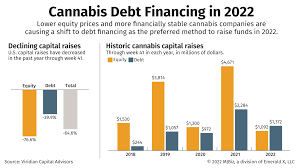

Capital raises in the U.S. marijuana industry are down nearly 65% this year versus 2021, but lower stock prices and more creditworthy cannabis companies mean debt financing is now the preferred method to raise funds for the first time in years.
Equity financing had dominated cannabis capital raises since at least 2018.
But so far this year, debt funding has dominated, according to data collected by New York-based cannabis capital, M&A and strategic advisory firm Viridian Capital Advisors.
To be sure, debt financing in the U.S. marijuana industry is down by 39.9% compared to last year from January to October, according to Viridian data.
But year-to-date, debt now makes up 93% of capital raised by U.S. cultivation and retail companies and 55.7% in the U.S. industry overall.
The shift comes as more companies have spruced up their balance sheets and are better positioned to repay loans.
Looking ahead, debt financing will continue to be the main means of raising capital until economic conditions change, according to analysts – think lower interest rates, higher stock prices, federal marijuana reform or some combination.
And despite this year’s shift in funding patterns, securing debt financing isn’t easy.
After bootstrapping ExtractionTek Stainless since 2011, Chief Marketing Officer Sean Winfield and his team at the Colorado-based company are at a crossroads.
The past two years of the COVID-19 pandemic have been tough, highlighted by supply-chain difficulties as well as added health and safety protocols at the extraction machinery company’s 30,000 square-foot manufacturing facility in Denver.
Now, ExtractionTek and its marijuana industry partners are battling lower cannabis prices at a time when the general economy is confronting raging inflation.
With expansion opportunities in emerging domestic markets and in Europe as well as his company’s plans to expand its training facility, Winfield is evaluating how best to secure investment of approximately $5 million for operating and growth capital.
What about debt financing?
Winfield winces at the word “debt” – something ExtractionTek has avoided taking on thus far.
“We don’t understand the implications of debt financing, necessarily,” Winfield said. “We need some further education, to find the right partners to really give us options that make sense and to educate us.”
Rising interest rates
Most debt-financing deals are made between private companies.
But two recent deals made by public companies demonstrate some of the intricacies involved, most notably how interest rates and other terms are pegged to overall interest rates as well as risk spreads – such as the ICE BofA US High Yield Index Option-Adjusted Spread.
(The spread measures the difference between an index of corporate bonds and rates on government-backed U.S. Treasury securities.)
Which is to say that debt financing is getting more expensive.
Earlier this month, the Maryland and New Jersey subsidiaries of Toronto-headquartered cannabis operator TerrAscend – which has operations in five states and Canada – closed a nondilutive, senior secured loan for $45.5 million from Pelorus Equity Group.
Pelorus lends against the hard and soft costs of the real estate owned by a company, said Travis Goad, the financier’s managing partner.
“We’re also collateralized by the operating company and a license as well, so that if something were to ever go wrong or there was an issue, we could sell a functioning cannabis facility or lease it to somebody else,” he explained.
“So we spend a lot of time underwriting on a per-square-foot basis what they should be able to produce in this market.”
The $45.5 million comes at a 12.77% floating interest rate, which Frank Colombo, director of data analytics at Viridian, predicts will likely appear in more cannabis debt-financing deals to come.
He cited the Federal Reserve’s recent interest rate increases to fight inflation as well as expectations of further rates hikes.
“Is that potentially risky for cannabis companies? Yes,” Colombo said. “Because it’s 12.77% now; by the time the Fed finishes raising rates, what will it be?
“It could be another 100 basis points up from that.”
Equity-linked debt financing on the rise
In August, California-based Lowell Farms raised a total of $6.4 million through two rounds of debt financing to be used for “working capital purposes, automation, investments and expansion into new markets,” according to a news release announcing the deal.
“We are grateful for investor support as a testimony to the strategy we have employed to differentiate ourselves,” Lowell Farms Chair George Allen said in a statement.
“This financing allows Lowell to bring capabilities to market that have been in development for years.”
Lowell secured a 5.5% interest rate, but the debentures are convertible and include exercisable warrants for shares of its subsidiary Indus Holding Co. at $0.2613 and a 42-month term from the date of issuance.
According to Viridian data, equity-linked debt deals dropped off earlier this year but have bounced back to account for about 50% of debt-financing deals in the U.S.
The difference this time around is that equity-linked deals are more expensive.
In 2021, larger multistate operators with good credit could finance debt for around 8%, according to Viridian data. In the case of Lowell, Colombo estimates the cost at around 30%.
“I think Lowell had a liquidity problem, and they needed to raise cash,” Colombo said. “It’s likely not a financing of opportunity but a financing of need.”
Lowell did not immediately return an MJBizDaily request for comment.
Private deals
Michigan-based retailer Noxx closed a $15 million debt-financing deal with Altmore Capital in August. The terms weren’t disclosed.
Noxx CEO Tommy Nafso said he pitched to about a half-dozen potential capital partners and received an array of offers before striking a deal with Altmore.
Nafso said he focused on clearly articulating:
- The market opportunities for the three retail licenses the company holds in Grand Rapids.
- The executive team’s experience working at companies such as Amazon, Ralph Lauren and Domino’s Pizza.
- Noxx’s customer-focused goals, future expansion plans and how well-positioned the company would be should market conditions change.
Since securing the funding, Noxx has opened its first store while investing in e-commerce, delivery services and ensuring the store design was as close to the renderings as possible.
“It feels like you’re in a different universe in our store,” Nafso gushed.
Last week, Noxx announced its latest phase of its growth plan: a partnership with Cookies, the California-based cannabis brand, to open a 3,000 square-foot Cookies location in Grand Rapids.
Watch for prepayment provisions
Colombo anticipates debt financing to continue to be the main means of raising capital until economic conditions change, with lower interest rates, stronger markets, legislative changes or a combination of the above.
But he warns borrowers to look beyond interest rates and closely at prepayment provisions.
If banking reform legislation passes – which would boost marijuana stock prices – or interest rates decrease, agreeing to a provision requiring a premium on a prepayment or a minimum number of earned interest could mean losing out on less expensive borrowing conditions in the future.
“That’s one of the reasons why debt is not as down as much (as equity),” Colombo said.
“If you have to raise money because you have a liquidity issue or maybe you have a really great opportunity that you have to come up with the cash for, the only way you’re going to really want to do it is with debt.”







After evading law enforcement for nearly 13 years, an accused linked to a large-scale pharmaceutical fraud case has been arrested by Delhi Police from Surat, Gujarat. The suspect is alleged to have orchestrated a series of financial scams involving fake identities, forged documents, and dishonoured cheques used to procure high-value pharmaceutical raw materials.
Authorities say the accused, identified as Himmat Singh Lodha, is believed to have defrauded multiple pharmaceutical companies in Delhi of goods worth approximately ₹98 lakh before disappearing and remaining underground for years.
Fake Business Deals and Dishonoured Cheques Used in Fraud
Investigators claim the accused posed as a legitimate pharmaceutical trader and placed bulk orders for expensive drug ingredients, offering post-dated cheques as payment security.
In one documented case from 2013, he allegedly obtained around 550 kilograms of Gliclazide, a diabetes-related pharmaceutical ingredient, valued at over ₹26 lakh. When suppliers attempted to encash the cheques, they were reportedly returned with the remark “account closed.”
Following the transaction, the accused allegedly vacated his office and rented residence and disappeared without settling payments. He was later declared a proclaimed offender in 2016 after repeatedly failing to appear before court proceedings. Authorities had also issued a reward for information leading to his arrest.
Multiple Identities and Repeated Fraud Pattern
Police investigations further link the accused to another cheating case dating back to 2012, where he allegedly used a fake identity, “Kailash Jain,” to obtain a large consignment of Ambroxol HCL, a pharmaceutical compound used in cough medications. The value of that consignment was estimated at around ₹72 lakh.
Officials believe the accused followed a consistent modus operandi—posing as a credible businessman, securing high-value goods on deferred payment terms, and then disappearing after delivery while shutting down business operations.
Investigators suspect that forged business records, fake company credentials, and fabricated financial histories were used to build trust with suppliers and gain access to expensive raw materials.
Multi-State Surveillance Leads to Arrest in Surat
A special Crime Branch team tracked the accused through coordinated surveillance efforts across multiple cities, including Mumbai, Ahmedabad, and Surat. After nearly a month of technical monitoring and intelligence gathering, officials located and arrested him from a residential area in Surat.
Authorities also revealed that the accused had been involved in property-related activities while staying under the radar to avoid detection.
Growing Threat of Corporate Identity Fraud
The case highlights a rising trend of organised financial fraud targeting industries that rely heavily on trust-based transactions and deferred payments. Experts note that criminals increasingly exploit gaps in corporate verification systems by using fake GST registrations, temporary offices, and forged documentation to appear legitimate.
Cybercrime and financial fraud specialists warn that such schemes are becoming more complex with the widespread availability of digital business tools, making it easier to create convincing but fraudulent corporate identities.
Experts Urge Stronger Due Diligence in High-Value Transactions
Experts, including former IPS officer and cybercrime specialist Prof. Triveni Singh, emphasize the need for stricter verification procedures in commercial dealings. He noted that relying solely on paperwork or digital business profiles can expose companies to significant financial risk.
Authorities and industry experts recommend physical verification of business operations, bank account validation, and detailed background checks before engaging in high-value or deferred-payment transactions—particularly in sectors like pharmaceuticals, where single consignments can involve transactions worth crores.
Business
EU Pressure Builds on Google as Regulators Face Calls for Massive Fine Over Search Practices


A growing coalition of European industry groups is intensifying pressure on regulators to take decisive action against Google over allegations of unfair search practices that could reshape competition rules across the region’s digital economy.
Investigation Under Digital Markets Act Gains Momentum
The case is being examined by the European Commission under the European Union’s landmark Digital Markets Act (DMA), introduced to curb the dominance of major technology platforms and ensure fair competition.
Launched in March 2024, the investigation focuses on whether Google has been prioritising its own services in search results, potentially disadvantaging rival businesses that rely on online visibility to reach customers.
Industry Groups Demand Swift Action
Several prominent European organizations have jointly urged regulators to conclude the probe without further delay. They argue that prolonged investigations allow alleged anti-competitive practices to continue, putting European companies—especially startups—at a disadvantage.
Signatories include the European Publishers Council, the European Magazine Media Association, the European Tech Alliance, and EU Travel Tech.
In a joint statement, these groups warned that delays in enforcement are affecting innovation, profitability, and growth prospects for regional businesses competing in digital markets.
Google Denies Allegations
Google has rejected claims of bias, stating that its search algorithms are designed to deliver the most relevant and useful results to users. The company has also proposed adjustments to address regulatory concerns.
However, critics argue that these changes are insufficient and fail to address the core issue of market dominance.
Potential Billion-Euro Penalties
If found in violation of the DMA, Google could face significant financial penalties. Under EU rules, fines can reach a substantial percentage of a company’s global turnover, potentially amounting to billions of euros.
Regulators may also impose corrective measures requiring changes to business practices, which could have long-term implications for how digital platforms operate in Europe.
Wider Implications for Big Tech
The case highlights ongoing tensions between European regulators and major U.S. technology firms. In recent years, the EU has taken a more aggressive stance in enforcing competition laws, aiming to create a level playing field for local businesses.
A final ruling against Google could set a major precedent, influencing future enforcement actions and shaping the regulatory landscape for global tech companies operating within Europe.
As scrutiny intensifies, the outcome of the investigation is expected to play a critical role in defining the future of digital competition across the European Union.
AI & Technology
Amazon Faces Potential Criminal Trial in Italy Over €1.2 Billion Tax Evasion Allegations

Milan: U.S. tech giant Amazon is facing the prospect of a major legal showdown in Italy, after prosecutors in Milan formally requested a court to move forward with criminal proceedings over alleged tax evasion totaling approximately ₹12,500 crore (€1.2 billion).
The case targets Amazon’s European division along with four senior executives, marking one of the most significant tax-related investigations involving a global e-commerce platform in Europe.
Trial Push Despite Multi-Million Euro Settlement
The move comes even after Amazon reached a financial settlement with Italian tax authorities in December, agreeing to pay around ₹5,500 crore (€527 million), including interest, to resolve part of the dispute.
Typically, such settlements lead to the closure of criminal investigations. However, Milan prosecutors have opted to proceed, signaling a tougher stance on alleged corporate tax violations.
A preliminary hearing is expected in the coming months, where a judge will decide whether to formally indict the company and its executives or dismiss the case.
Allegations of VAT Evasion Through Marketplace Sellers
At the center of the investigation are claims that Amazon’s platform enabled non-European Union sellers to avoid paying value-added tax (VAT) on goods sold to Italian consumers between 2019 and 2021.
Prosecutors allege that the company’s marketplace structure allowed thousands of foreign vendors—many reportedly based in China—to operate without fully disclosing their identities or tax obligations. This, authorities argue, led to substantial VAT losses for the Italian government.
Under Italian law, online platforms facilitating sales can be held partially liable if third-party sellers fail to comply with tax requirements, a key point in the prosecution’s case.
Italian Government Named as Affected Party
In their filing, prosecutors identified Italy’s Economy Ministry as the injured party, citing significant financial damage resulting from the alleged tax evasion.
Legal experts say the outcome of the case could have wide-ranging implications across the European Union, where VAT systems are harmonized and similar compliance rules apply to digital marketplaces.
Multiple Investigations Add to Pressure
The VAT probe is just one of several legal challenges facing Amazon in Italy. The European Public Prosecutor’s Office is reportedly examining additional tax-related issues covering more recent years.
Meanwhile, Milan authorities are pursuing separate investigations into alleged customs fraud linked to imports from China and whether Amazon maintained an undeclared “permanent establishment” in Italy—potentially exposing it to higher tax liabilities.
In a separate regulatory action, Italy’s data protection authority recently ordered an Amazon unit to stop using personal data from over 1,800 employees at a warehouse near Rome.
Amazon Denies Allegations
Amazon has consistently denied wrongdoing and indicated it will strongly contest the allegations in court if the case proceeds. The company has also warned that prolonged legal uncertainty could impact investor confidence and Italy’s appeal as a destination for international business.
Broader Impact on Europe’s Digital Economy
If the case moves to trial, it could become a landmark moment for the regulation of global e-commerce platforms in Europe. Governments across the region are increasingly scrutinizing how digital marketplaces handle tax compliance, especially in cross-border transactions.
With online retail continuing to expand, regulators are under mounting pressure to ensure that multinational platforms and third-party sellers adhere to the same tax rules as traditional businesses.
-

 Business3 years ago
Pot Odor Does Not Justify Probable Cause for Vehicle Searches, Minnesota Court Affirms
-

 Business3 years ago
New Mexico cannabis operator fined, loses license for alleged BioTrack fraud
-

 Business3 years ago
Alabama to make another attempt Dec. 1 to award medical cannabis licenses
-

 Business3 years ago
Washington State Pays Out $9.4 Million in Refunds Relating to Drug Convictions
-

 Business3 years ago
Marijuana companies suing US attorney general in federal prohibition challenge
-

 Business3 years ago
Legal Marijuana Handed A Nothing Burger From NY State
-

 Business3 years ago
Can Cannabis Help Seasonal Depression
-

 Blogs3 years ago
Cannabis Art Is Flourishing On Etsy