
Business & Economy
YouTube Is Now a ₹18,000 Crore Economic Engine in India

India’s YouTube creator economy has grown into a significant digital business ecosystem, contributing an estimated ₹18,000 crore to the country’s GDP in 2025 and supporting approximately 9.6 lakh jobs, according to a new report.
The figures highlight how online video has evolved beyond entertainment and personal content. Creators now operate businesses that depend on advertising, brand partnerships, production services, digital marketing and other parts of the wider online economy.
More Than 20,000 Indian Channels Have Over 1 Million Subscribers
The scale of India’s YouTube ecosystem has expanded rapidly. According to the report, more than 20,000 channels in India had crossed the one-million-subscriber mark by June 2026.
Reaching such an audience can turn a YouTube channel into a substantial commercial operation. Large channels can generate revenue through advertising while also attracting sponsorships, brand collaborations and other business opportunities.
The growth is not restricted to a handful of entertainment channels. Creators are producing content across education, technology, gaming, food, travel, fitness, news, lifestyle and regional culture.
Regional Content Helps Expand YouTube’s Reach
India’s diverse language landscape has played an important role in the expansion of online video.
Creators from smaller cities and towns are increasingly producing content in regional languages, allowing them to connect with audiences that may not primarily consume English-language videos.
Improved internet access and widespread smartphone use have also lowered the barriers to becoming a content creator. A person can now build an audience without the traditional infrastructure associated with television or other mainstream media.
High-Earning YouTube Channels Are Increasing
The report also points to growth in the number of Indian YouTube channels generating substantial revenue.
The number of channels earning ₹10 lakh or more annually increased by more than 20% in a year, according to the report. The increase suggests that monetisation opportunities are expanding as more creators build sizable audiences and develop multiple income streams.
Advertising remains an important source of revenue, but creators can also earn through sponsored campaigns, brand partnerships and other commercial arrangements connected to their audiences.
YouTube Supports Jobs Beyond Content Creation
The economic impact of YouTube extends well beyond the creators appearing on camera.
A successful channel can require video editors, graphic designers, camera operators, sound specialists, writers, social media managers, digital marketers and administrative staff. Businesses working with creators also contribute to advertising, production, equipment and brand-management activities.
Taking this broader ecosystem into account, the report estimates that YouTube’s creator economy supported approximately 9.6 lakh jobs in India during 2025.
This means the platform’s economic footprint includes both direct creator-related work and employment generated by businesses serving the growing digital-content industry.
From YouTube Channels to Digital Businesses
For many creators, a channel is no longer simply a place to upload videos. It can function as a digital business built around a specific audience and subject.
Creators can use their reach to work with brands, promote products and services, develop partnerships and create additional commercial opportunities. This has encouraged an expanding network of agencies and freelancers specializing in editing, design, marketing, sponsorship management and other creator services.
However, revenue remains uneven across the industry. Subscriber numbers alone do not guarantee a particular income level, as earnings can vary according to audience engagement, content category, advertising demand, geography and the creator’s monetisation strategy.
India’s Creator Economy Continues to Expand
The latest figures demonstrate the growing economic importance of online video in India. The reported ₹18,000 crore GDP contribution and 9.6 lakh jobs supported by the YouTube creator ecosystem illustrate how digital content has developed into a broader commercial sector.
With thousands of channels reaching million-subscriber audiences and the number of higher-earning creators continuing to increase, YouTube is becoming an important part of India’s digital economy.
The expansion also shows how content creation is generating opportunities across a much wider network of professionals, from editors and designers to marketers, advertisers and production specialists.

India’s Goods and Services Tax (GST) framework is entering a new phase of technology-led reform as authorities increasingly adopt artificial intelligence, advanced analytics, and digital verification systems to improve compliance and streamline tax administration.
As the indirect tax regime completes nearly a decade since its launch, policymakers are focusing on reducing manual intervention, enhancing transparency, and improving efficiency across the taxation ecosystem.
Government Shifts Focus to AI-Based Compliance Systems
Officials say the next phase of GST reforms will prioritise artificial intelligence-driven monitoring tools, faster refund processing, and automated data validation rather than a sole focus on tax rate adjustments.
The objective is to simplify compliance for businesses—especially micro, small and medium enterprises (MSMEs)—while strengthening the government’s ability to detect tax irregularities through integrated data systems.
Authorities are also working toward deeper coordination between GST, income tax, and customs databases. This integration is expected to enable real-time identification of inconsistencies and improve enforcement efficiency using data-driven insights.
GST’s Journey From Tax Reform to Digital Ecosystem
Introduced on July 1, 2017, GST replaced a complex structure of multiple indirect taxes with a unified national framework aimed at creating a “One Nation, One Tax” system.
Since its rollout, the number of registered taxpayers has grown significantly—from about 66.5 lakh in 2017 to nearly 1.6 crore in 2026—reflecting wider adoption and formalisation of the tax base.
Over time, the tax structure has also evolved, with periodic revisions to rate slabs and classification categories. Essential goods have largely been rationalised across standardised brackets, while higher rates continue to apply to luxury and demerit items.
GST Revenues Show Strong Long-Term Growth
Government data indicates steady growth in GST collections over the past decade. Average monthly revenue, which stood at around ₹89,700 crore during the initial implementation phase, has risen to approximately ₹1.85 lakh crore in 2025–26.
Total GST collections for the financial year 2025–26 reached an estimated ₹22.27 lakh crore, marking an increase of 8.3% compared to the previous year.
However, petroleum products remain outside the GST framework due to lack of consensus between the Centre and states on inclusion within the unified tax system.
Digital Integration to Strengthen Tax Enforcement
Looking ahead, authorities plan to expand the use of AI and analytics across tax administration systems to detect evasion patterns and improve compliance accuracy.
The proposed framework aims to integrate GST with income tax and customs data, enabling a more comprehensive and automated monitoring system for financial transactions and filings.
Officials believe this shift will reduce paperwork, improve refund timelines, and create a more transparent and efficient tax environment for businesses and individuals alike.
Business & Economy
VP Radhakrishnan Urges MSMEs to Harness AI for Viksit Bharat at the International MSME Day 2026 Event
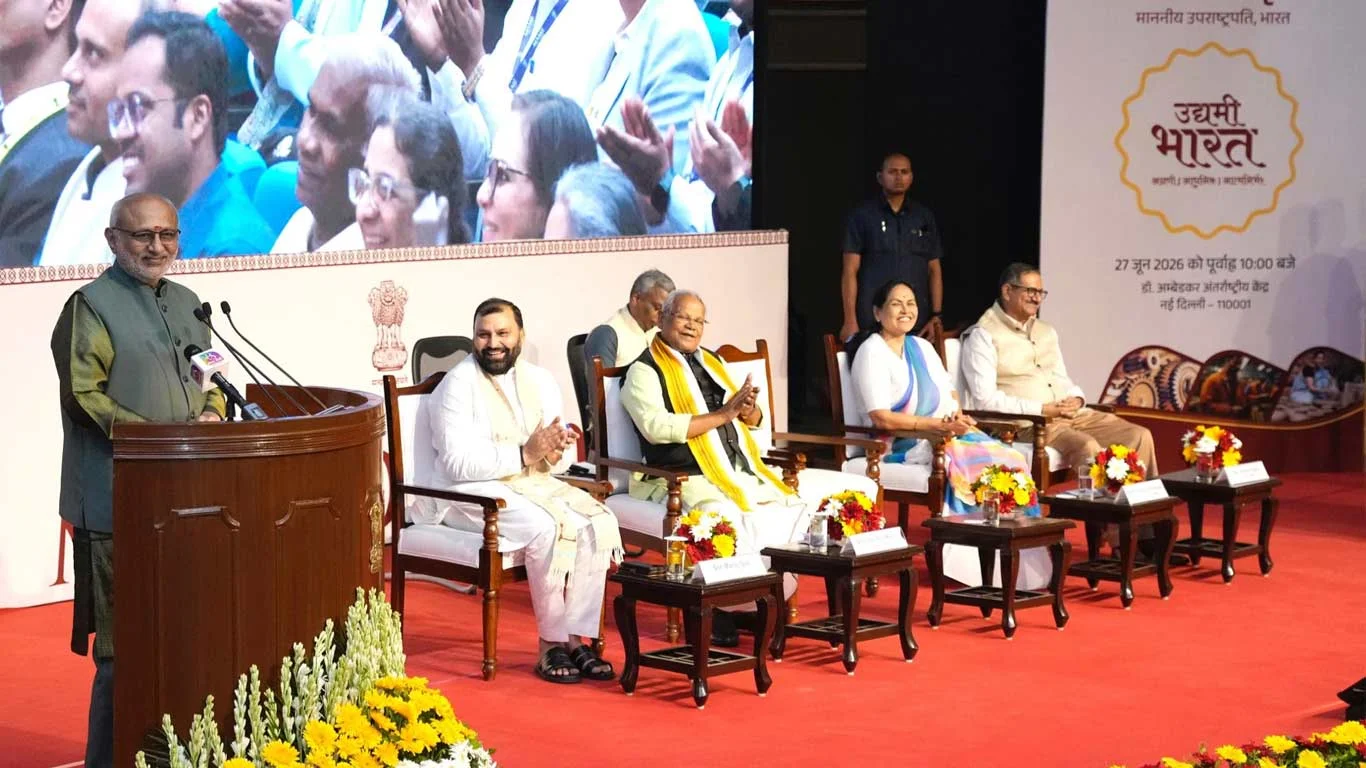
At the International MSME Day 2026 celebrations held at the Dr. Ambedkar International Centre, Vice President C. P. Radhakrishnan emphasized that Micro, Small, and Medium Enterprises (MSMEs) will play a defining role in achieving India’s long-term development vision of “Viksit Bharat @2047.”
Addressing the ‘MSME Day 2026–Udyami Bharat’ gathering, the Vice President described MSMEs as the backbone of India’s economy, representing the ambition of young entrepreneurs, the determination of first-generation business owners, and the resilience of small industries across the country. He noted that India’s journey toward becoming a developed nation will be strongly driven by this sector’s growth and innovation.
MSMEs urged to scale up with quality and ambition
Drawing from his experience in public service and industry leadership, Radhakrishnan encouraged entrepreneurs to stay committed to their businesses and overcome early-stage challenges with persistence. He stressed that maintaining high product and service quality is essential for survival in a competitive global marketplace.
While cost efficiency remains important, he cautioned that it should never compromise standards. He also called on enterprises to continuously expand their scale of operations, urging micro businesses to grow into small enterprises and small firms to evolve into medium-sized companies.
He highlighted the importance of supportive policies, easier access to credit, and increased investment to enable sustained growth within the MSME ecosystem.
AI and digital tools positioned as growth drivers
A major focus of the Vice President’s address was the growing importance of Artificial Intelligence (AI) and digital transformation. Aligning with the global theme “Human-Centered Entrepreneurship in an AI-Driven Future,” he encouraged MSMEs to embrace emerging technologies as opportunities rather than threats.
He compared current AI-driven changes to earlier technological shifts such as the introduction of computers, which initially raised concerns but eventually created new jobs and industries. According to him, AI can significantly enhance productivity, innovation, and global competitiveness for small businesses.
Government launches new digital platforms for MSMEs
The event also saw the unveiling of several digital initiatives aimed at strengthening India’s MSME ecosystem:
- PMEGP 2.0 Portal: Designed to streamline beneficiary processes and integrate with Jan Samarth Portal for faster credit access.
- SAMADHAAN 2.0 Portal: A system to track delayed payments owed to MSMEs by government departments and agencies.
- MSME Global Mart 2.0: Integrated with the Open Network for Digital Commerce (ONDC), it aims to expand market access for small businesses across India and abroad.
- Multilingual AI Support System: An AI-based platform offering services in 22 Indian languages, including voice-based grievance redressal and document translation to improve accessibility.
Push toward a digitally empowered MSME sector
The government’s continued rollout of digital platforms reflects a broader strategy focused on formalization, innovation, and technology adoption within the MSME sector. Officials said these initiatives are designed to improve ease of doing business, enhance transparency, and help small enterprises compete in both domestic and global markets.
With AI integration and digital infrastructure gaining momentum, policymakers believe MSMEs are well-positioned to become a central force in India’s economic transformation.

India’s Goods and Services Tax (GST) collections hit a new high in February 2026, with gross revenue exceeding ₹1.83 trillion, marking an 8.1 percent increase over the same period last year. The surge has been largely supported by rising import-related tax revenue and stable domestic consumption across key sectors.
Strong Domestic Revenue Signals Economic Stability
Domestic GST collections grew by approximately 5.3 percent to nearly ₹1.36 trillion. Analysts attribute this rise to consistent consumer spending, stable business operations, and the expanding adoption of digital payment platforms. Improved tax compliance and structured electronic invoicing systems have also contributed to strengthening revenue inflows.
Import Tax Revenue Jumps 17.2 Percent
Import-based GST revenue recorded the most notable increase, rising 17.2 percent to around ₹47,837 crore. Experts point to higher demand for imported raw materials and India’s deeper integration into global supply chains as key factors behind this sharp growth. The increase in import duties has significantly bolstered the overall fiscal position.
Refunds Processed to Maintain Liquidity
To support business liquidity, the government disbursed approximately ₹22,595 crore in GST refunds, a 10.2 percent rise from the previous year. After accounting for refunds, the net GST collection stood at over ₹1.61 trillion, reflecting a year-on-year growth of roughly 7.9 percent.
Cess Revenue Shows Decline
While overall GST collections rose, cess revenue declined to nearly ₹5,063 crore from ₹13,481 crore in February 2025. Economists suggest that changes in consumption patterns and adjustments in the tax structure contributed to the drop in cess collections.
Digital Compliance and Fiscal Outlook
The continued growth in GST revenue highlights the strengthening of India’s digital transaction ecosystem and effective tax compliance measures. Authorities have been enhancing technological monitoring systems to curb tax evasion and expand the tax base. Analysts note that sustained GST growth supports fiscal balance, public expenditure programs, and infrastructure initiatives, though global trade volatility and geopolitical uncertainties remain potential risks for future revenue trends.
The government has indicated that efforts will continue to expand digital taxation frameworks, improve compliance, and ensure transparency to maintain stability in revenue collection across sectors.
-

 Business3 years ago
Pot Odor Does Not Justify Probable Cause for Vehicle Searches, Minnesota Court Affirms
-

 Business3 years ago
New Mexico cannabis operator fined, loses license for alleged BioTrack fraud
-

 Business3 years ago
Alabama to make another attempt Dec. 1 to award medical cannabis licenses
-

 Business3 years ago
Washington State Pays Out $9.4 Million in Refunds Relating to Drug Convictions
-

 Business3 years ago
Marijuana companies suing US attorney general in federal prohibition challenge
-

 Business3 years ago
Legal Marijuana Handed A Nothing Burger From NY State
-

 Business3 years ago
Can Cannabis Help Seasonal Depression
-

 Blogs3 years ago
Cannabis Art Is Flourishing On Etsy