
World News
Iranian Naval Vessel Reportedly Sinks Near Sri Lanka; Over 100 Missing After Suspected Attack

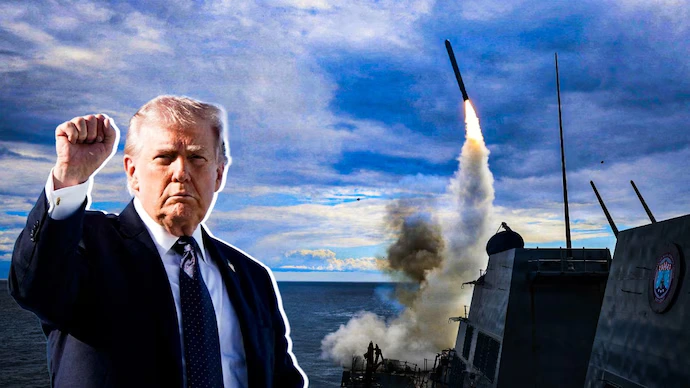
A major maritime incident in the Indian Ocean has raised fresh security concerns after an Iranian naval vessel reportedly sank near the southern coast of Sri Lanka, leaving more than 100 personnel feared missing. The ship was reportedly located roughly 400 kilometers from Kanyakumari, a strategic point at the southern tip of India.
Preliminary reports indicate that around 180 individuals were onboard the vessel at the time of the incident. So far, 32 people have been rescued, while search operations continue amid difficult sea conditions.
Vessel Had Participated in International Naval Exercise
According to early reports, the Iranian ship had recently participated in the MILAN 2026 naval exercise and was returning from the event when the incident occurred on March 4.
The vessel reportedly encountered trouble while passing through an international maritime route south of Sri Lanka. Authorities say distress alerts were received shortly after the incident, triggering an immediate rescue mission in the area.
Officials estimate that dozens of crew members remain unaccounted for, prompting an extensive search operation involving naval and aerial units.
Rescue Efforts Underway as Survivors Receive Treatment
Health officials in Sri Lanka confirmed that the rescued personnel were transported to nearby medical facilities.
Among the survivors:
- One individual remains in critical condition
- Seven others are undergoing emergency treatment
- Several rescued crew members have received primary medical care and are under observation
Joint teams from the Sri Lankan Navy and Air Force are continuing search-and-rescue operations in the surrounding waters.
Alleged Drone and Submarine Strike Under Investigation
Initial reports circulating among regional security sources claim the vessel may have been targeted in an attack involving a drone and a submarine allegedly linked to the United States.
However, no official confirmation has been issued by either the United States or Iran, and investigators are still working to determine the exact cause of the sinking.
Witness accounts and early assessments suggest that a fire broke out on board shortly after the strike, followed by rapid flooding that ultimately caused the ship to sink.
Rising Tensions in the Indian Ocean
Security analysts warn that the incident could intensify tensions linked to the broader geopolitical rivalry between Iran and the United States.
The Indian Ocean is a vital corridor for global shipping and energy transportation. A large portion of the world’s oil and gas shipments pass through nearby maritime routes, making the region strategically important for international trade.
Experts caution that any escalation of military activity in these waters could disrupt global supply chains and increase security risks for commercial vessels.
Sri Lanka Strengthens Maritime Security
Following the incident, the government of Sri Lanka announced that maritime security measures have been intensified along key coastal areas.
Authorities have also issued advisories to vessels navigating nearby sea lanes, urging heightened vigilance while the investigation continues.
Additional naval assets have been deployed to assist rescue teams as they search for survivors in deep-water zones where rough weather and strong currents are complicating operations.
Officials say the exact circumstances of the sinking remain under investigation, and a clearer picture is expected once maritime authorities complete their inquiry.



Corporate Compliance
Austrian Ex-Billionaire Rene Benko Gets 30-Month Sentence in Insolvency Fraud Retrial

Former Austrian billionaire Rene Benko has received an increased prison sentence after an Innsbruck court convicted him in a retrial over a €360,000 advance rent payment made before the collapse of his business empire.
The court added the new conviction to Benko’s earlier insolvency-fraud conviction involving a €300,000 payment to his mother. His combined sentence has now risen from two years to 30 months.
The latest ruling follows a decision by Austria’s Supreme Court that overturned Benko’s earlier acquittal on the advance-rent allegation and ordered the case to be reconsidered.
Court Finds Benko Guilty Over €360,000 Rent Payment
The retrial focused on an advance payment of €360,000 for a villa in Innsbruck’s Hungerburg district, where Benko lived.
Prosecutors argued that the payment was made while Benko was already facing serious financial difficulties and that transferring the money reduced assets that could otherwise have been available to creditors.
Benko had initially been acquitted of this allegation during his October 2025 trial. However, prosecutors challenged that decision, leading Austria’s Supreme Court to overturn the acquittal and send the matter back to the Innsbruck Regional Court.
At the retrial, the court found Benko guilty of the insolvency-related offense and reassessed his overall sentence.
He was, however, acquitted of separate allegations concerning advance operating expenses connected with the same property.
Earlier Conviction Involved Payment to His Mother
Benko’s first conviction in the case concerned a €300,000 transfer to his mother.
The court previously determined that the payment reduced funds that could have been used to satisfy creditors. Benko received a two-year prison sentence in that case.
Austria’s Supreme Court subsequently upheld that conviction while ordering a retrial on the separate advance-rent allegation.
With the second conviction now entered, the court increased Benko’s total prison term by six months to two and a half years.
Why the Transactions Became a Criminal Issue
Insolvency-related criminal cases can examine whether a financially distressed individual deliberately transfers or spends assets in ways that disadvantage creditors.
In Benko’s case, prosecutors focused on transactions made when his financial position was already under significant pressure. Their argument was that the disputed payments reduced the pool of assets available to people and institutions seeking repayment.
The Supreme Court’s earlier decision to order a retrial did not itself establish Benko’s guilt over the rent payment. That question was left for the lower court to determine, resulting in Tuesday’s conviction.
Further legal options may still be available under Austrian law.
Signa Collapse Brings Wider Investigations
Benko was the founder of Signa, a major property and retail group that expanded throughout Austria, Germany and other European markets.
The group relied heavily on financing and accumulated substantial property and retail interests. Rising interest rates, increasing construction costs and mounting financial pressure contributed to its collapse in late 2023.
The failure of Signa became one of Austria’s largest corporate insolvencies since World War II, leaving creditors and investors facing significant losses.
Benko has been in pre-trial detention since January 2025 as authorities continue investigating his financial activities.
Additional Criminal Proceedings Remain Pending
The latest conviction represents only one part of the broader legal investigations surrounding Benko and Signa.
Austria’s Economic and Corruption Prosecutor’s Office announced another indictment in June involving allegations of serious fraud and fraudulent insolvency. In that separate case, prosecutors allege that a private foundation suffered losses of approximately €5 million after relying on an allegedly false guarantee.
Those allegations are separate from the convictions addressed in the latest retrial and remain subject to court proceedings.
What the 30-Month Sentence Means
The latest ruling resolves the specific €360,000 advance-rent allegation that was sent back for retrial by Austria’s Supreme Court.
The case also illustrates how transactions carried out shortly before insolvency can come under criminal scrutiny when authorities believe they reduced assets available to creditors.
However, the 30-month sentence relates to the specific offenses considered by the court and does not determine the outcome of other investigations involving Benko, Signa or their associated transactions.

Former US President Donald Trump has once again thrust Greenland into the global geopolitical spotlight, warning that the United States would be prepared to “take action” to prevent Russia or China from expanding their influence over the Arctic island. Calling Greenland vital to American national security, Trump suggested that Washington could not remain passive—even if such moves faced opposition from Denmark.
Speaking to reporters, Trump said Greenland’s strategic position and growing economic value made it too important to ignore. He argued that failure to act could allow rival powers to gain a foothold dangerously close to the United States. While he said diplomacy would be preferable, Trump made it clear that tougher measures remained on the table if needed.
The remarks revive controversy from Trump’s time in office, when he openly floated the idea of acquiring Greenland—an idea swiftly rejected by Denmark and criticized across Europe.
Why Greenland Has Become Strategically Crucial
Greenland, an autonomous territory within the Kingdom of Denmark, occupies a commanding position in the Arctic. As rising temperatures reduce ice cover, new shipping routes and access to untapped natural resources, including rare earth minerals, are becoming increasingly viable.
The United States already maintains a significant military footprint on the island through Pituffik Space Base (formerly Thule Air Base), a critical hub for missile defense and Arctic surveillance. Security experts note that control and access in the Arctic are becoming central to future military and economic planning.
Trump questioned the permanence of historical sovereignty claims, arguing that strategic realities must take precedence in a rapidly changing world. Analysts say his comments reflect broader US concerns about Russia’s expanding Arctic military infrastructure and China’s growing scientific and commercial ambitions in polar regions.
Denmark and Europe Reject the Rhetoric
Denmark responded firmly, reiterating that Greenland is not for sale and that its future must be decided in accordance with international law and democratic principles. Danish Prime Minister Mette Frederiksen warned that confrontational language could damage European security and strain transatlantic relations.
European officials echoed these concerns, emphasizing that the Arctic has long been governed through cooperation and multilateral frameworks. Any unilateral action, they cautioned, risks destabilizing a region already under pressure from climate change and emerging security rivalries.
Greenland’s Own Perspective
Leaders in Greenland stressed that decisions about the island’s future belong to its people. While Greenland has steadily expanded its self-governance—particularly over natural resources—it still relies on Denmark for defense and foreign affairs.
Local authorities have generally welcomed US investment and security cooperation but have strongly opposed any suggestion of coercion or loss of autonomy. Greenlandic officials have repeatedly stated that engagement must respect their identity, rights, and long-term development goals.
NATO and Alliance Tensions
Trump’s warning has also raised questions within NATO, of which both the United States and Denmark are members. Security analysts caution that internal disagreements over Greenland could complicate alliance unity at a time when NATO faces heightened pressure from Russia and growing concern over China’s global reach.
Greenland’s location places it at the intersection of climate change, defense strategy, and great-power competition—making it a sensitive flashpoint with implications far beyond the Arctic.
A Debate That Is Far From Settled
Although Trump is no longer in office, his remarks have reignited an already delicate debate about Arctic sovereignty and security. Observers note that statements from influential political figures can still shape diplomatic calculations, particularly as competition intensifies in the far north.
For now, Denmark and its European partners are calling for restraint and dialogue. But with Greenland’s strategic importance only increasing, the island is set to remain a focal point of global power politics for years to come.
Bengaluru:
A major corruption case has rocked the Central Power Research Institute (CPRI), a key government laboratory responsible for testing and certifying electrical equipment used across India’s power sector. The Central Bureau of Investigation (CBI) has arrested a senior official and a private company executive for allegedly running a bribe-for-report racket that compromised technical clearances in exchange for illegal payments.
The agency claims the scam involved issuing favourable test reports to private firms, regardless of whether their products met mandatory safety and quality standards.
Senior CPRI Official Caught Taking Bribe
The CBI arrested Rajaram Mohanrao Chennu, Joint Director at CPRI, after allegedly catching him red-handed while accepting a bribe of ₹9.5 lakh on January 9, 2026. Investigators say the money was paid to secure “pass” or “conforming” test reports for electrical equipment submitted by private companies.
In the same case, Atul Khanna, Director of the Sudhir Group of Companies, has also been arrested for allegedly offering the bribe to influence the testing outcome.
Complaint Leads to Trap Operation
According to CBI officials, the case was initiated following a complaint from a private firm that alleged routine demands for illegal gratification in exchange for favourable test results. A preliminary verification reportedly revealed that the accused official frequently interfered with the testing process and manipulated certification outcomes.
Based on these findings, the agency laid a trap and apprehended the Joint Director while he was allegedly accepting the bribe at a pre-arranged location in Bengaluru.
Massive Cash and Foreign Currency Recovered
Following the arrests, the CBI conducted searches at the accused official’s residence and other associated premises. These searches led to the recovery of more than ₹3.59 crore in unaccounted cash, along with foreign currency valued at over ₹4 lakh.
Officials said the seized foreign currency included US dollars, euros, Hong Kong dollars, Singapore dollars, UAE dirhams, Chinese yuan, Swedish krona, Malaysian ringgit, and Indonesian rupiah. The total seizure has so far crossed ₹3.76 crore, and search operations are continuing at additional locations.
Alleged Long-Running Racket Under Probe
Preliminary findings suggest that the accused may have been engaged in corrupt practices for a considerable period, systematically abusing his position to benefit select private firms. The CBI is now examining whether the case is part of a larger organised network involving middlemen, multiple companies, and possibly other officials within or outside CPRI.
Investigators are reviewing past test reports issued under the officer’s supervision to determine whether compromised clearances were routinely granted to substandard or non-compliant products.
Serious Implications for Public Safety
CPRI plays a critical role in testing and certifying equipment such as transformers, cables, switchgear, and other electrical components essential to India’s power infrastructure. Officials warned that any dilution of testing standards could pose serious risks, including safety hazards, infrastructure failures, and significant financial losses.
The CBI is also scrutinising bank accounts, financial transactions, call records, and asset details of the accused, while mapping communication with company executives to identify other beneficiaries of the alleged scam.
Case Registered Under Corruption Laws
The agency has registered the case under relevant provisions of the Prevention of Corruption Act and other applicable laws. Officials stated that strict action will be taken against all individuals found involved, regardless of their rank or position.
The CBI has indicated that the investigation may expand further, with the possibility of additional arrests as financial trails are traced and evidence is analysed.
-

 Business3 years ago
Pot Odor Does Not Justify Probable Cause for Vehicle Searches, Minnesota Court Affirms
-

 Business3 years ago
New Mexico cannabis operator fined, loses license for alleged BioTrack fraud
-

 Business3 years ago
Alabama to make another attempt Dec. 1 to award medical cannabis licenses
-

 Business3 years ago
Washington State Pays Out $9.4 Million in Refunds Relating to Drug Convictions
-

 Business3 years ago
Marijuana companies suing US attorney general in federal prohibition challenge
-

 Business3 years ago
Legal Marijuana Handed A Nothing Burger From NY State
-

 Business3 years ago
Can Cannabis Help Seasonal Depression
-

 Blogs3 years ago
Cannabis Art Is Flourishing On Etsy