
Business
From the Archives: Hash in the U.S.S.R. (1974)

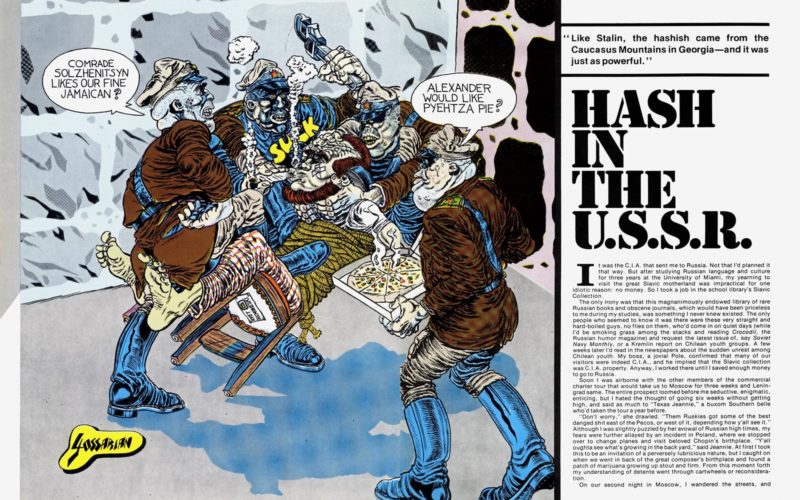
“Like Stalin, the hashish came from the Caucasus Mountains in Georgia—and it was just as powerful.”
It was the C.I.A. that sent me to Russia. Not that I’d planned it that way. But after studying Russian language and culture for three years at the University of Miami, my yearning to visit the great Slavic motherland was impractical for one idiotic reason: no money. So I took a job in the school library’s Slavic Collection.
The only irony was that this magnanimously endowed library of rare Russian books and obscene journals, which would have been priceless to me during my studies, was something I never knew existed. The only people who seemed to know it was there were these very straight and hard-boiled guys, no flies on them, who’d come in on quiet days (while I’d be smoking grass among the stacks and reading Crocodil, the Russian humor magazine) and request the latest issue of, say Soviet Navy Monthly, or a Kremlin report on Chilean youth groups. A few weeks later I’d read in the newspapers about the sudden unrest among Chilean youth. My boss, a jovial Pole, confirmed that many of our visitors were indeed C.I.A., and he implied that the Slavic collection was C.I.A. property. Anyway, I worked there until I saved enough money to go to Russia.
Soon I was airborne with the other members of the commercial charter tour that would take us to Moscow for three weeks and Leningrad same. The entire prospect loomed before me seductive, enigmatic, enticing, but I hated the thought of going six weeks without getting high, and said as much to “Texas Jeannie,” a buxom Southern belle who’d taken the tour a year before.
“Don’t worry,” she drawled. “Them Ruskies got some of the best danged shit east of the Pecos, or west of it, depending how y’all see it.” Although I was slightly puzzled by her avowal of Russian high times, my fears were further allayed by an incident in Poland, where we stopped over to change planes and visit beloved Chopin’s birthplace. “Y’all oughta see what’s growing in the back yard,” said Jeannie. At first I took this to be an invitation of a perversely lubricious nature, but I caught on when we went in back of the great composer’s birthplace and found a patch of marijuana growing up stout and firm. From this moment forth my understanding of detente went through cartwheels or reconsideration.
On our second night in Moscow, I wandered the streets, and returned from sightseeing to find a note from Jeannie on my hotel door. When I got to her room, I found her and five other tourists sitting around on the floor, their heads obscured by a cloud of familiar-smelling smoke. At Jeannie’s welcome bidding, I fell to my knees and was handed a pipeful of dark green flakes of kaif, which smells like hashish but tasted like grass. It had come from the Caucasus Mountains in Georgia—just like Stalin—and it was just as powerful.
Jeannie had traded one of her many pair of blue jeans to a Russian head for the kaif we were smoking. She explained that the hunger of Russian youth for things American, like jeans, rock and jazz albums, psychedelic posters, and what have you, is so great that they’ll barter samovars, balalaikas, perhaps military secrets, and of course kaif in the most promiscuous fashion to get their hands on the trappings of decadent Amerikan youth culture. The realization that my old Moby Grape albums were the equivalent of cigarettes and stockings in a Saigon black market brought home to me the ineffable karmic value of never throwing away anything, no matter how faddy or ephemeral it may seem to jaded American hippies.
During my last week in Moscow, I was with some of my new Russian friends looking for a place to party. This is a great problem in Russia because of the acute housing shortage, which forces the Russians to live in rather close quarters. I was reminded of the familiar high school scene back home, where large parts of our youth are spent scouting locations to make out in.
Russians find it odd that Americans all have their own apartments, cars, food, cigarettes, orgasms: in the Soviet Union, these things are collectivized. Old and young must share their living rooms, their likes and dislikes, their cutlery and crockery, their vodka and ideologies, which are “monolithic” only in their mutual antagonism.
In short, the chances of our finding an orgy site seemed slim, when my friend Volodya struck up a conversation with a little man sporting a black goatee and heavy horn-rim glasses thick as stove lids. He turned out to be a sort of Russian bohemian, and in minutes had invited us to his apartment in a tottering old housing project. He told us we could use his little two-room “flet”, even his bed, while he socialized with us and shared our wine and kaif.
As it turned out, he fancied himself a painter and his apartment was crowded with awful day-glo canvasses of dogs pissing into space, lampposts shooting darts at children, and a picture of a man spreading his arsecheeks to reveal a peep at the infinite cosmos through his hole. Our host was one of those genuine Mad Russians you hear about. Twelve of us packed boisterously into the tiny place, puffing pipes of kaif and taking turns balling on the bed; the little man got wilder and wilder, drinking more than half of our wine. We played some of my rock albums—Hendrix and Pink Floyd—on his record player. I asked him if he had any examples of Russian rock music, and he replied, “You want to see example of Russian rock, da?” “Da,” I said. He went to a shelf and took down a paperjacketed album. He placed the record on the turntable, we listened for no more than a few seconds, and then he heaved the record out the window. “That’s Russian music,” he said.
“I knew Nicholas before he was a superstar,” he raved, reminiscing about his family. “My mother-in-law boy, is she fat! I took her to the Mayday parade and a C.I.A. Man offered to buy my missile secrets. . . . No, really, she’s very talented. She’s being sent to America on the cultural exchange program. In exchange, we’re getting Texas, Brooklyn, and Raquel Welch!” He began to roar out his life story, which became more and more horrible. Finally he dropped his trousers to show a long ugly scar left by Stalin’s torturers. At one point, I was bedding a young Muscovite honey when the Mad Russian ran in, brandishing a small scimitar. My friends dragged him away, and soon we left him sleeping on the floor, his snores and nightmarish outcries mingling with the laughter, sobs, arguments, and songs that poured into the common courtyard from every apartment. Somehow, the whole episode seemed to epitomize Moscow.
Leningrad is closer to the West than Moscow in more ways than one. During the centuries of Tsarist rule, the city reflected the Romanovs’ imitation of Western European culture. Even now that tradition persists. Walking down the Nevsky Prospect for the first time, I actually felt at ease among the younger, long-haired, more stylishly attired communists, some of whom were actually promenading in tie-dyed shirts.
The kids are hip and kaif is plentiful. With three young Komsomoltsy (members of the Lenin Youth Organization) I dropped in one evening to a local disco called the “Molotok” to hear the top local rock band. Their music, consisting of loud fancy guitar chords, lots of showy drum licks, and [an] almost funky bass line, was surprisingly together, and reminiscent of the high school bands that played in garages back home. On an impulse, I asked the drummer if I could sit in for one number. “Konyeshno!” he cried, smiling. The leader then announced that an American rock and roller was going to play, and that brought down the house.
I could barely hear myself through their applause and shouts. For the next several days I was followed around by several “groupskies” who believed I was a big rock star, and I did nothing to disillusion them.
Soon I met my first Russian dope dealer. His name was Misha, and he was as freaky as any Russian could hope to be. He was tall, swarthy, and bearded. He lived in his black market Levis and cowboy jacket. A signpainter by profession, he spent his time with foreign tourists and sold them dope, and had, in fact, served five years in a concentration camp for this activity. In a bastardized argot of hip Russian and Leningrad street slang, he invited us to his apartment to smoke some gashgish.
Gashgish is the people’s hash, imported from the Uzbekistan, a central Asian Soviet Republic near Afghanistan. He shared his apartment with a comely Lenin youth named Natasha. Our first time there, Misha emptied a papirosa (cigarette), and mixed the bitter Russian tobacco with some hash from a small leather pouch, then poured the mixture adroitly into the cigarette. I found it a bit harsh, but what the hell.
Later I gave Misha an American pipe and some screens and he was so impressed (and stoned) that he vowed never to smoke hash in cigarettes again, but Natasha swore, in her revisionist way, to go on smoking good Soviet papirosas. She did, however, take to “shotgunning” her reefers quite hungrily.
Misha’s scene was pretty loose, so one day I asked him what the neighbors thought.
“They think I am crazy,” he said. “And do you know, they are right? Every time they see me coming, the old one-leg and the ugly witch, they run into their rooms and slam the doors.” I regaled him with a few Florida redneck tales.
The last time I saw Misha, we got higher than Yuri Gagarin. Dostoeyevsky, that dark Russian, who once said, “consciousness is a disease,” would have been proud of us. Our minds met in cosmic detente, and Misha and I became increasingly mystic. A very Russian thing to be. I told him of my long-time dream of getting stoned with a genuine Russian. He told me about his dream of getting stoned with a real American.
“Est bog!” he cried excitedly, “there is a god!”

Source: https://hightimes.com/culture/from-the-archives-hash-in-the-u-s-s-r-1974/












Reliance Jio has crossed a significant milestone in its space connectivity ambitions after its proposal to deploy a Low Earth Orbit (LEO) satellite constellation of around 1,600 satellites received a positive technical assessment from the Indian National Space Promotion and Authorisation Centre (IN-SPACe).
The evaluation, conducted jointly by IN-SPACe, the Indian Space Research Organisation (ISRO), and the Wireless Planning and Coordination (WPC) wing of the Department of Telecommunications, reportedly concluded that Jio’s proposed system meets the required technical standards and is comparable to leading global satellite broadband networks.
India’s Indigenous LEO Satellite Vision
Under the proposal, Reliance Jio plans to deploy between 1,600 and 1,650 satellites in Low Earth Orbit at an altitude of around 650 kilometres.
The planned constellation is expected to provide high-speed satellite connectivity across India, with approximately 32 satellites visible from any location at a given time. The company aims to roll out the network within the next two to three years, subject to regulatory approvals.
According to industry estimates, the satellite system could deliver 4.5 to 5 terabits per second (Tbps) of total data capacity, making it one of the largest satellite broadband projects proposed in India.
The project is expected to require an investment of $10–15 billion (approximately ₹95,000 crore to ₹1.42 lakh crore), reflecting the scale of infrastructure needed for satellite manufacturing, launches, ground stations, and user terminals.
Regulatory Process Moves Forward
Following the successful technical review, the proposal is expected to move into the next phase of regulatory approvals.
The government may now assist Jio in securing orbital slots, coordinating spectrum usage, and filing applications with the International Telecommunication Union (ITU), the global body responsible for managing satellite orbit and frequency allocations.
Obtaining orbital rights remains a critical step, as Low Earth Orbit has become increasingly competitive due to the growing number of satellite broadband projects being planned worldwide.
Officials also indicated that the proposed satellite architecture has been designed to coexist with future Indian LEO constellations, allowing multiple domestic operators to share orbital resources efficiently.
Broadband, Mobile Connectivity, and Strategic Applications
Jio plans to use the satellite network to provide a range of communication services, including satellite broadband, mobile backhaul, enterprise connectivity, and direct-to-device (D2D) satellite communication, particularly in remote and underserved regions where conventional telecom infrastructure is limited.
The company also intends to establish 20 to 22 ground stations across India to support network operations.
Apart from commercial telecommunications, officials have highlighted the project’s potential strategic importance. A domestically developed satellite constellation could strengthen India’s communication infrastructure, reduce dependence on foreign satellite operators, and support national security requirements.
Reports suggest preliminary discussions are underway regarding the possibility of integrating defence-related payloads into some satellites, enabling both civilian and strategic use.
Major Step for India’s Space and Telecom Sectors
Industry analysts view the technical clearance as an important milestone in India’s expanding private space ecosystem. If Jio secures the remaining regulatory approvals and international orbital clearances, the project could become the country’s first large-scale indigenous LEO satellite broadband network.
The initiative also aligns with India’s broader efforts to expand digital connectivity while strengthening its presence in the global satellite communications market.

After evading law enforcement for nearly 13 years, an accused linked to a large-scale pharmaceutical fraud case has been arrested by Delhi Police from Surat, Gujarat. The suspect is alleged to have orchestrated a series of financial scams involving fake identities, forged documents, and dishonoured cheques used to procure high-value pharmaceutical raw materials.
Authorities say the accused, identified as Himmat Singh Lodha, is believed to have defrauded multiple pharmaceutical companies in Delhi of goods worth approximately ₹98 lakh before disappearing and remaining underground for years.
Fake Business Deals and Dishonoured Cheques Used in Fraud
Investigators claim the accused posed as a legitimate pharmaceutical trader and placed bulk orders for expensive drug ingredients, offering post-dated cheques as payment security.
In one documented case from 2013, he allegedly obtained around 550 kilograms of Gliclazide, a diabetes-related pharmaceutical ingredient, valued at over ₹26 lakh. When suppliers attempted to encash the cheques, they were reportedly returned with the remark “account closed.”
Following the transaction, the accused allegedly vacated his office and rented residence and disappeared without settling payments. He was later declared a proclaimed offender in 2016 after repeatedly failing to appear before court proceedings. Authorities had also issued a reward for information leading to his arrest.
Multiple Identities and Repeated Fraud Pattern
Police investigations further link the accused to another cheating case dating back to 2012, where he allegedly used a fake identity, “Kailash Jain,” to obtain a large consignment of Ambroxol HCL, a pharmaceutical compound used in cough medications. The value of that consignment was estimated at around ₹72 lakh.
Officials believe the accused followed a consistent modus operandi—posing as a credible businessman, securing high-value goods on deferred payment terms, and then disappearing after delivery while shutting down business operations.
Investigators suspect that forged business records, fake company credentials, and fabricated financial histories were used to build trust with suppliers and gain access to expensive raw materials.
Multi-State Surveillance Leads to Arrest in Surat
A special Crime Branch team tracked the accused through coordinated surveillance efforts across multiple cities, including Mumbai, Ahmedabad, and Surat. After nearly a month of technical monitoring and intelligence gathering, officials located and arrested him from a residential area in Surat.
Authorities also revealed that the accused had been involved in property-related activities while staying under the radar to avoid detection.
Growing Threat of Corporate Identity Fraud
The case highlights a rising trend of organised financial fraud targeting industries that rely heavily on trust-based transactions and deferred payments. Experts note that criminals increasingly exploit gaps in corporate verification systems by using fake GST registrations, temporary offices, and forged documentation to appear legitimate.
Cybercrime and financial fraud specialists warn that such schemes are becoming more complex with the widespread availability of digital business tools, making it easier to create convincing but fraudulent corporate identities.
Experts Urge Stronger Due Diligence in High-Value Transactions
Experts, including former IPS officer and cybercrime specialist Prof. Triveni Singh, emphasize the need for stricter verification procedures in commercial dealings. He noted that relying solely on paperwork or digital business profiles can expose companies to significant financial risk.
Authorities and industry experts recommend physical verification of business operations, bank account validation, and detailed background checks before engaging in high-value or deferred-payment transactions—particularly in sectors like pharmaceuticals, where single consignments can involve transactions worth crores.
Business
EU Pressure Builds on Google as Regulators Face Calls for Massive Fine Over Search Practices


A growing coalition of European industry groups is intensifying pressure on regulators to take decisive action against Google over allegations of unfair search practices that could reshape competition rules across the region’s digital economy.
Investigation Under Digital Markets Act Gains Momentum
The case is being examined by the European Commission under the European Union’s landmark Digital Markets Act (DMA), introduced to curb the dominance of major technology platforms and ensure fair competition.
Launched in March 2024, the investigation focuses on whether Google has been prioritising its own services in search results, potentially disadvantaging rival businesses that rely on online visibility to reach customers.
Industry Groups Demand Swift Action
Several prominent European organizations have jointly urged regulators to conclude the probe without further delay. They argue that prolonged investigations allow alleged anti-competitive practices to continue, putting European companies—especially startups—at a disadvantage.
Signatories include the European Publishers Council, the European Magazine Media Association, the European Tech Alliance, and EU Travel Tech.
In a joint statement, these groups warned that delays in enforcement are affecting innovation, profitability, and growth prospects for regional businesses competing in digital markets.
Google Denies Allegations
Google has rejected claims of bias, stating that its search algorithms are designed to deliver the most relevant and useful results to users. The company has also proposed adjustments to address regulatory concerns.
However, critics argue that these changes are insufficient and fail to address the core issue of market dominance.
Potential Billion-Euro Penalties
If found in violation of the DMA, Google could face significant financial penalties. Under EU rules, fines can reach a substantial percentage of a company’s global turnover, potentially amounting to billions of euros.
Regulators may also impose corrective measures requiring changes to business practices, which could have long-term implications for how digital platforms operate in Europe.
Wider Implications for Big Tech
The case highlights ongoing tensions between European regulators and major U.S. technology firms. In recent years, the EU has taken a more aggressive stance in enforcing competition laws, aiming to create a level playing field for local businesses.
A final ruling against Google could set a major precedent, influencing future enforcement actions and shaping the regulatory landscape for global tech companies operating within Europe.
As scrutiny intensifies, the outcome of the investigation is expected to play a critical role in defining the future of digital competition across the European Union.
-

 Business3 years ago
Pot Odor Does Not Justify Probable Cause for Vehicle Searches, Minnesota Court Affirms
-

 Business3 years ago
New Mexico cannabis operator fined, loses license for alleged BioTrack fraud
-

 Business3 years ago
Alabama to make another attempt Dec. 1 to award medical cannabis licenses
-

 Business3 years ago
Washington State Pays Out $9.4 Million in Refunds Relating to Drug Convictions
-

 Business3 years ago
Marijuana companies suing US attorney general in federal prohibition challenge
-

 Business3 years ago
Legal Marijuana Handed A Nothing Burger From NY State
-

 Business3 years ago
Can Cannabis Help Seasonal Depression
-

 Blogs3 years ago
Cannabis Art Is Flourishing On Etsy